
Hershey-Chase Experiment
Hershey-Chase Experiment Animation
In 1952, Hershey and chase infected bacteria with T2 phages that had been radioactively labeled either in their DNA component (with 32P) or in their protein component (with 32S).The infected bacteria were agitated in a blender, and two fractions were separated by centrifugation. One contained the empty phage coats that were released from the surface of the bacteria; these consist of protein and therefore carried the 32S radioactive label. The other fraction consisted of the infected bacteria themselves. Most of the 32P label was present in the infected bacteria. The progeny phage particles produced by the infection contained 30% of the original 32P label. The progeny received very little less than 1% of the protein contained in the original phage population.
This experiment therefore showed directly that the DNA of parent phages enters the bacteria and than becomes part of the progeny phages, exactly the pattern of inheritance expected of genetic material.
- Product
- Qty in Cart
- Quantity
- Price
- Subtotal
-

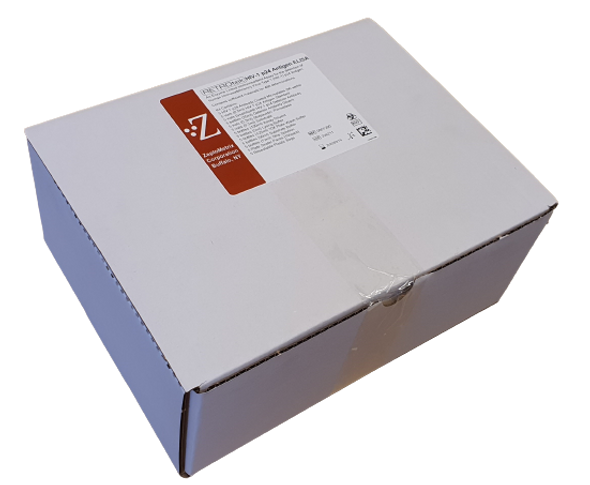
HIV-1 p24 Antigen ELISA 2.0
The RETRO-TEK HIV-1 p24 Antigen ELISA 2.0 is an enzyme linked immunoassay used to detect Human Immunodeficiency Virus Type 1 (HIV-1) p24 antigen in cell culture media. It can be used to monitor the purification and biochemical behavior of HIV-1 or...0801002/0801008Qty in Cart: 0Quantity:Price:Subtotal: -

MS2 Bacteriophage
MS2 Bacteriophage- Low (1 EA= 0.1 mL) #0810052 MS2 Bacteriophage- Low (1 EA= 1.0 mL) #0810066 MS2 Bacteriophage - Medium (1 EA= 1 mL) #0810274 PRODUCT DESCRIPTION: Each frozen aliquot contains 0.1 or 1 mL of partially purified, live, titered MS2...0810052/0810066Qty in Cart: 0Quantity:Price:Subtotal: -


HIV-1 p24 Antigen ELISA
The RETRO-TEK HIV-1 p24 Antigen ELISA is supplied for research purposes only. It is not intended for use in the diagnosis or prognosis of disease, or for screening and may not be used as a confirmatory test in diagnostic situations. The RETRO-TEK HIV-1...0801111/0801200Qty in Cart: 0Quantity:Price:Subtotal: -
Anti-HIV Type 1 p24 Clone 38/8.7.47
Anti-HIV-1 p24 (clone 38/8.7.47) exhibits reactivity by Western blot analysis of viral lysates and may be used in indirect immunostaining techniques to detect HIV-1 p24 core protein in fresh or cultured HIV-1 infected cells. In addition, the antibody...0801004/0801125Qty in Cart: 0Quantity:Price:Subtotal: -
 Qty in Cart: 0Quantity:Price:Subtotal:
 -

Mouse IgG ELISA
The IMMUNO-TEK Mouse IgG ELISA Kit is a rapid, easy to use enzyme-linked immunosorbent assay (ELISA) designed for the measurement of mouse IgG in plasma, serum, hybridoma cell supernatants, ascites or other mouse biological fluids. The kit is also useful...801180Qty in Cart: 0Quantity:Price:Subtotal: -

HIV-1 p24 ICx/CRx
The RETRO-TEK HIV-1 ICx/CRx Kit is supplied for research purposes only. It is not intended for use in the diagnosis or prognosis of disease or for screening and may not be used as a confirmatory test in diagnostic situations. HIV-1 p24 antigen may be...801096Qty in Cart: 0Quantity:Price:Subtotal: -


HIV Type 1 p24 Extended Range Kit
The RETRO-TEK HIV-1 p24 Extended Range Kit is supplied for research purposes only. It is not intended for use in the diagnosis or prognosis of disease or for screening and may not be used as a confirmatory test in diagnostic situations. It is to be used...801137Qty in Cart: 0Quantity:Price:Subtotal: -

The IMMUNO-TEK Bovine IgG ELISA Kit | 801198
The IMMUNO-TEK Bovine IgG ELISA Kit is a rapid, easy to use enzyme linked immunosorbent assay (ELISA) designed for the measurement of bovine IgG in bovine colostrum, milk, serum, plasma or other biological fluids. The assay contains mostly ready-to-use...801198Qty in Cart: 0Quantity:Price:Subtotal: